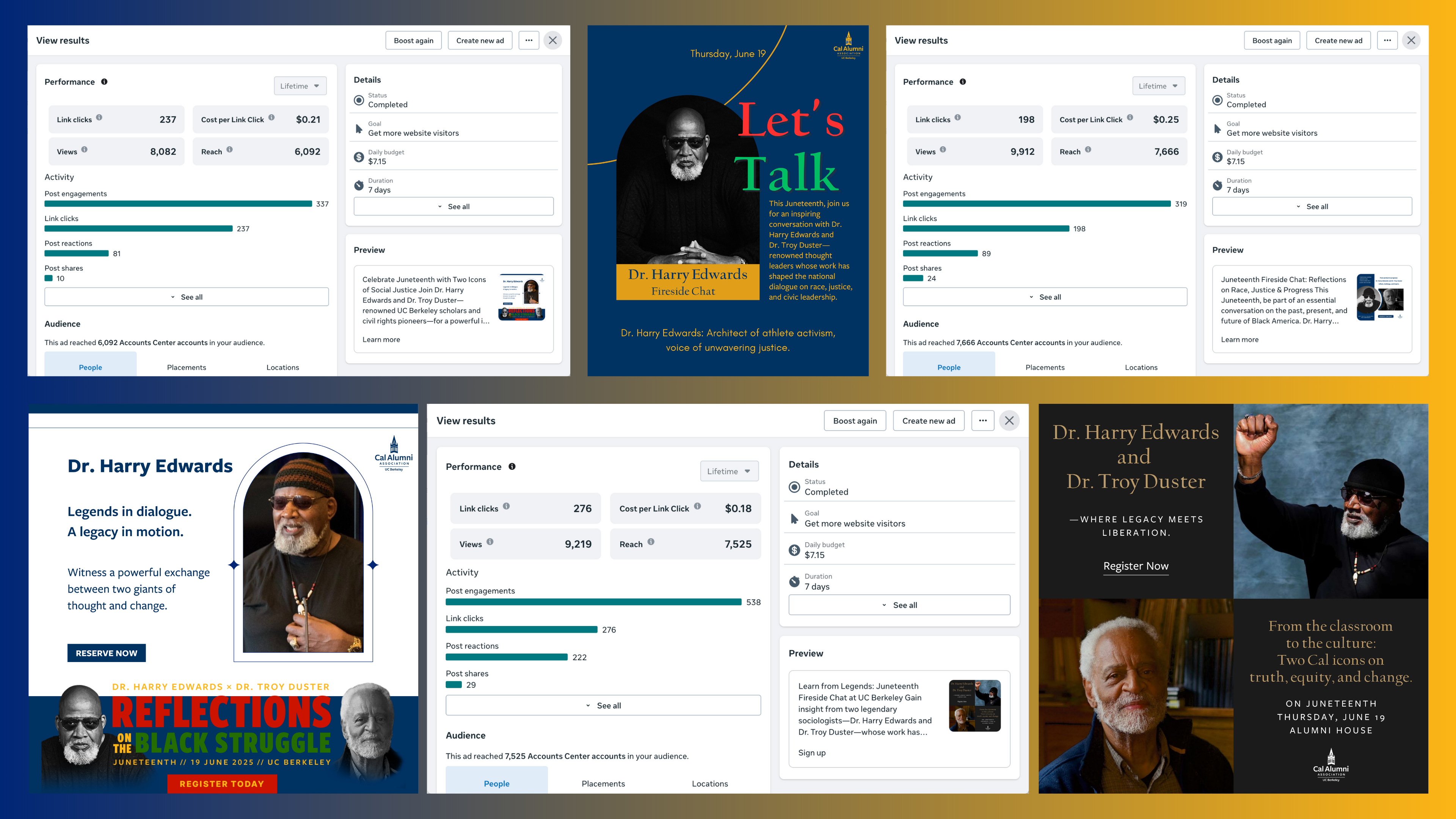
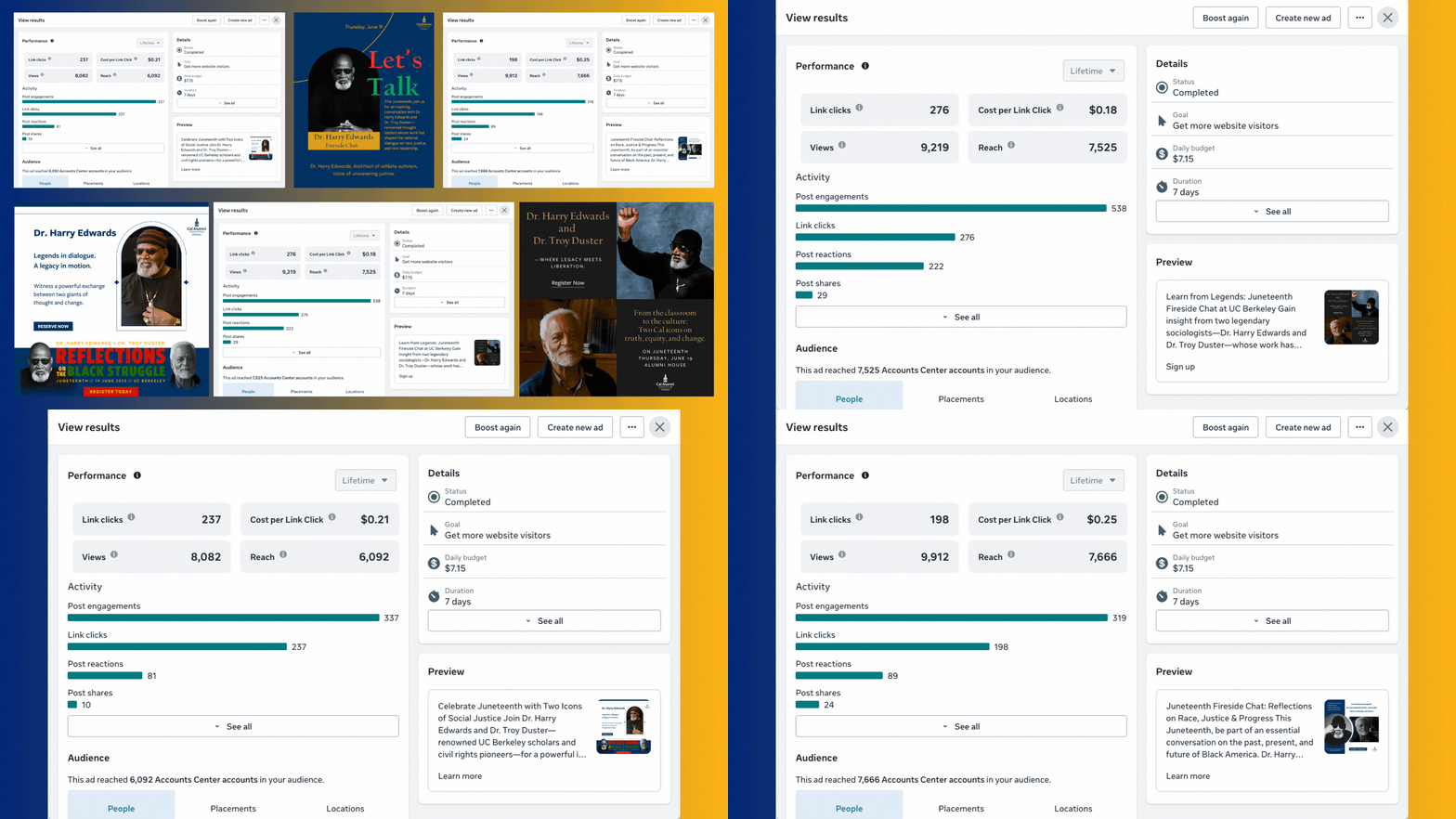
Drove a cross-channel campaign (organic + three paid boosts) to promote CAA’s Juneteenth fireside chat with two renowned civil-rights scholars. Clear value framing, authority-led visuals, and conversion-focused copy sold the event out in 3 days while delivering efficient paid performance at scale.
Positioned the event as a must-attend conversation on race, justice, and progress—anchored by Berkeley’s legacy and the credibility of Dr. Harry Edwards and Dr. Troy Duster. Used a blend of editorial storytelling tiles, concise value props, and single-purpose CTAs that funneled traffic to registration.
Challenge
Juneteenth is a crowded content window; attention is fragmented.
Limited ad budget; success required high CTR and rapid RSVP velocity.
Needed to speak to alumni, students, and broader Bay Area community without diluting message.
Strategy
Authority first: Lead with speakers’ stature + Berkeley heritage to trigger trust.
Clarity over cleverness: Plain-language value prop (“Learn from legends. Essential conversation on the past, present, future of Black America.”).
One job per asset: Each creative optimized for a single action—“Learn more / Sign up.”
Momentum design: Staggered creative variants to sustain freshness across the 3-day sellout window.
Lightweight paid, heavy intent: Link-click objective to maximize qualified traffic at low CPC.
Execution
Creative: Speaker portraits + bold headline lockup; high-contrast typography; short body copy; button-style CTA.
Formats: Static tiles + link-preview variants; boosted across three creatives.
Cadence: Publish → immediate boost → rotate creatives on day 2–3 to maintain novelty while keeping CTA constant.
On-page friction fixes: Tight meta title/description and above-the-fold “Register” on landing (coordination with web team, where applicable).
Community lift: Prompted staff/partners to reshare in the first 24 hours to build early social proof.
Neuromarketing Approach
Authority bias: Featuring two legendary scholars increases perceived value and click propensity.
Social identity priming: “Berkeley community” + “Juneteenth” cues heighten relevance and belonging.